Colorado’s Amendment 83: A Threat to Science-Based Wildlife Management and the Public’s Voice
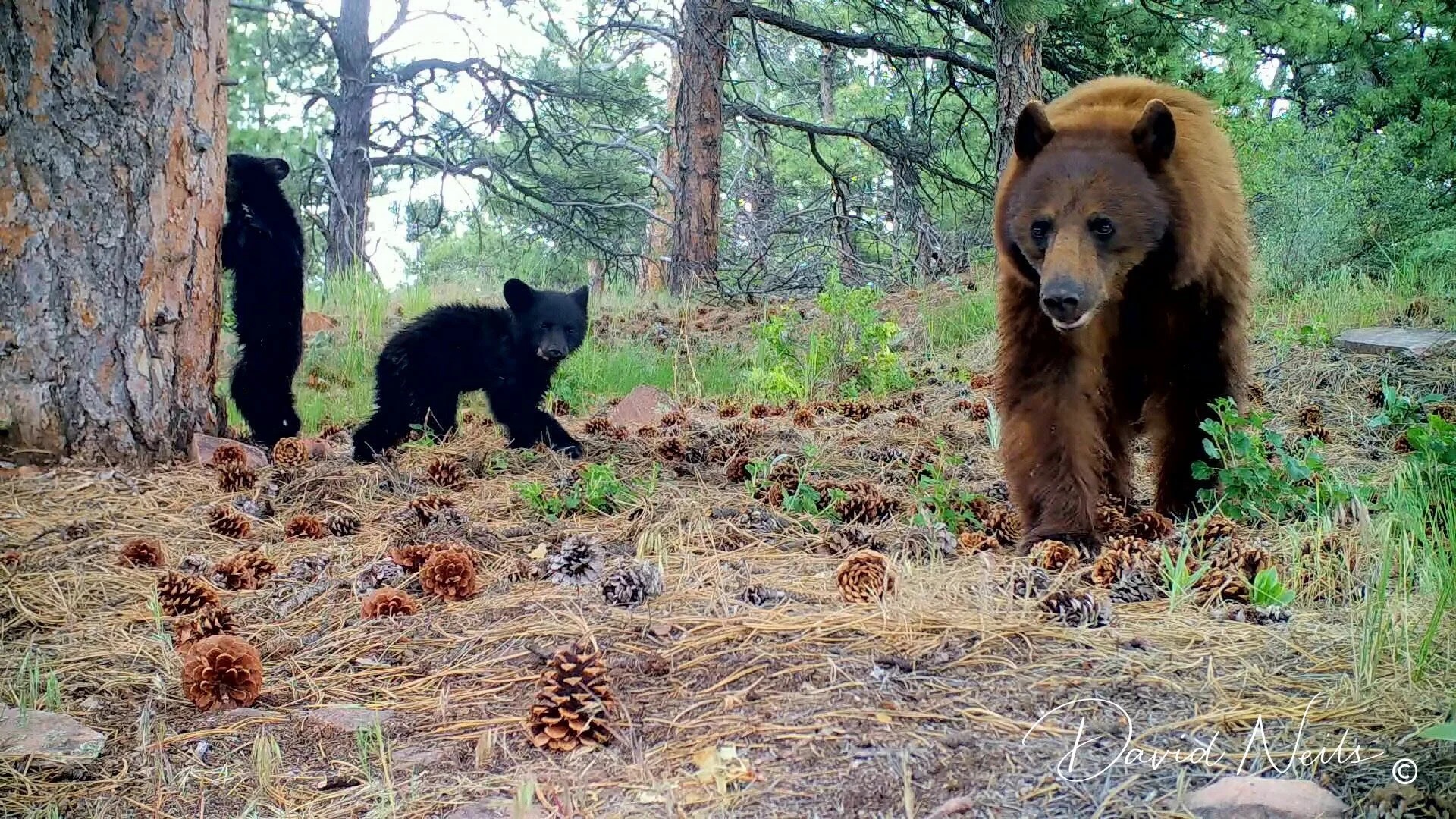
A black bear sow and her two cubs near Lyons, Colorado. Amendment 83 opens the door to bring back spring bear hunting with hounds and baiting, leaving orphaned cubs to starve to death. Wildlife deserve better. Vote NO on Amendment 83!
Colorado’s wildlife belongs to all of us. Its future should be guided by sound science, ecological responsibility, and public accountability—not by a constitutional mandate that elevates hunting and trapping above other approaches to wildlife management.
Colorado’s wildlife is one of our state’s greatest natural treasures. From mountain lions moving silently through forested valleys to black bears raising their cubs, bobcats hunting along riparian corridors, and beavers creating wetlands that sustain countless other species, these animals are essential threads in the fabric of our natural world.
Protecting this extraordinary heritage requires thoughtful, science-based wildlife management that considers the needs of wildlife, the health of ecosystems, and the interests of all Coloradans.
That is why Colorado Amendment 83, the proposed constitutional Right to Hunt measure, deserves serious opposition. I share this as a lifetime hunter, fisherman and most importantly, a wildlife advocate and conservationist.
Although the language of hunting rights may sound straightforward, the implications of placing hunting and trapping at the center of wildlife management are far-reaching. A constitutional amendment is not an ordinary regulation. It can establish principles that constrain future policy decisions, limit flexibility, and make it more difficult for future generations to respond to new scientific evidence and changing public values.
Colorado should be moving toward more comprehensive, humane, and scientifically defensible wildlife management—not locking itself into a narrower vision of how wildlife must be managed.
1. Wildlife management must be guided by science, not a constitutional preference for hunting and trapping
One of the central concerns with Amendment 83 is its elevation of hunting and trapping as primary methods of wildlife management.
Hunting and trapping are human activities. Wildlife management, by contrast, is a public responsibility that must account for the biology of individual species, population dynamics, habitat conditions, ecological relationships, animal welfare, and the long-term health of entire ecosystems.
There are circumstances in which regulated hunting may serve a defensible management purpose. But it does not follow that hunting and trapping should receive constitutional preference over other tools, regardless of the species involved, the available evidence, or the management objective.
Effective wildlife management should begin with fundamental questions:
What does the best available scientific evidence tell us about the species and its population?
What ecological role does the species play?
What management objective are we trying to achieve, and is that objective supported by evidence?
Are nonlethal alternatives available and effective?
What are the likely consequences for animal welfare, habitat, and the broader ecosystem?
How will we independently evaluate whether the management strategy is working?
These questions should determine the appropriate management approach—not a predetermined preference for hunting or trapping.
Colorado Parks and Wildlife (CPW) must retain the flexibility to use the most appropriate tools for each species and situation. A constitutional mandate that elevates particular methods risks putting the preferred activity ahead of the biological and ecological realities those methods are supposed to address.
2. Colorado’s wildlife belongs to the public—not just those who hunt and trap
Colorado's wildlife is a public trust. Its management affects everyone, whether they hunt, trap, photograph wildlife, hike, birdwatch, conduct research, work in conservation, or simply value knowing that wild animals continue to thrive across our landscapes.
Wildlife advocates, conservation organizations, independent scientists, photographers, educators, and ordinary citizens all have legitimate interests in how these shared natural resources are managed.
Yet a constitutional framework that privileges hunting and trapping risks giving one set of interests a disproportionate influence over decisions that affect every Coloradan.
The right to participate in wildlife policy should not depend on whether someone hunts or traps.
Public participation is not an obstacle to effective management. It is an essential part of accountable government. Different perspectives can reveal overlooked ecological consequences, identify humane alternatives, and challenge assumptions that deserve closer scientific scrutiny.
Wildlife advocates should not be shut out of meaningful decisions about the future of Colorado's animals. Nor should their concerns be dismissed simply because they favor coexistence, nonlethal management, or stronger protections for individual animals.
A public resource deserves a public process—one in which the interests of wildlife and the full range of public perspectives receive meaningful consideration.
3. Vague language about “traditional methods” raises serious concerns
Perhaps one of the most troubling aspects of the debate surrounding Amendment 83 is the potential for broad appeals to “traditional methods” to be used to justify practices that many Coloradans consider unnecessarily cruel.
Tradition, by itself, is not a scientific management objective. Nor does the historical use of a practice establish that it is humane, ecologically beneficial, or appropriate under modern conditions.
Wildlife management should be willing to reconsider practices when new evidence, improved technology, or a better understanding of animal behavior reveals a more responsible path forward.
Coloradans should be concerned about any interpretation of traditional methods that could be used to weaken existing restrictions or revive controversial practices, including:
Leghold traps: Devices that can restrain animals by a captured limb, causing distress, injury, and prolonged suffering before the animal is discovered.
Chasing bears with hounds: Pursuit that can subject bears to considerable stress and exhaustion, with potential consequences for animals that are pursued or cornered.
Baiting bears: The use of food attractants to draw bears to locations where they can be hunted, raising concerns about conditioning wildlife to human-associated food sources and the broader consequences for coexistence.
Spring bear hunting: Hunting during a season when females may have dependent cubs, creating the risk that young bears will be orphaned and left without the care and protection they need to survive.
These practices are not interchangeable, and each has its own legal, ecological, and animal-welfare considerations. But they share an important question: Should historical precedent or a broad appeal to tradition be enough to protect a practice from meaningful public and scientific scrutiny?
The answer should be no.
If a method is proposed for wildlife management, it should have to withstand scrutiny based on current evidence, demonstrable management benefits, animal welfare, and the availability of alternatives. No practice should be insulated from that review simply because it has been used in the past.
4. Spring bear hunting can leave dependent cubs without their mothers
Among the most troubling potential consequences of wildlife policies that prioritize harvest is the risk to dependent young animals.
Black bears have a long period of maternal care. Cubs rely on their mothers for protection, guidance, and the development of behaviors essential to survival. When a mother bear is killed while her cubs remain dependent, those cubs may be left without the care they need to survive.
Spring hunting raises particular concerns because female bears may emerge from winter dens with young cubs. The death of a mother can leave those cubs orphaned, exposed, and vulnerable to starvation or predation.
This is not simply an abstract debate about population management. It concerns the fate of individual animals and the responsibilities we accept when we choose to intervene in their lives.
Any wildlife management program that permits the killing of animals should carefully consider these consequences. The existence of a hunting season does not, by itself, establish that its timing, methods, or effects on dependent young are justified.
Colorado should pursue wildlife policies that minimize avoidable suffering and take the full consequences of management decisions seriously.
5. Colorado voters have already established important protections for wildlife
Colorado has a history of citizens stepping forward to protect wildlife when they believe existing policies fall short.
In 1996, Colorado voters approved Amendment 14, which prohibited certain trapping methods, including leghold traps, snares, and poisons for wildlife capture, subject to the amendment's provisions and exceptions. Those protections reflected a public decision about the methods Coloradans were willing to accept.
Amendment 83 does not explicitly repeal Amendment 14 or automatically legalize the practices discussed here. Its proponents argue that existing regulations would remain in place. The measure also retains state regulatory authority for specified purposes, including sound scientific wildlife conservation and management.
Nevertheless, Amendment 83 would add constitutional language establishing hunting and fishing as the preferred means of managing wildlife and protecting the use of traditional methods. Because the amendment does not define those methods, questions could arise about how its new constitutional provisions interact with existing wildlife protections.
That uncertainty matters.
A practice that is currently prohibited should not be brought back through legal challenges made possible by ambiguous constitutional language. Nor should wildlife advocates have to spend years defending existing protections in court because the state constitution has been amended to give hunting and fishing a preferred status.
Once a constitutional amendment is adopted, changing it is far more difficult than revising an ordinary statute or regulation. It takes a statewide vote to amend the Colorado Constitution again.
Colorado should not create lasting constitutional uncertainty around wildlife protections that voters have already chosen to establish.
6. Wildlife management must consider the entire ecosystem
Wildlife cannot be managed responsibly by looking only at the number of animals available for harvest.
Every species plays a role in a larger ecological community. Mountain lions influence the movements and behavior of deer and elk. Beavers create wetlands that store water and provide habitat for numerous species. Bobcats, foxes, and other predators participate in complex relationships that help shape healthy ecosystems.
These relationships are not always simple, and management decisions must reflect the best available evidence for each species and place. But the underlying principle is clear: wildlife management should consider more than whether animals can be harvested.
Habitat quality, water availability, disease, migration, reproduction, human-wildlife conflict, and the effects of climate change all influence wildlife populations. In many situations, habitat restoration, improved fencing, wildlife crossings, attractant management, relocation, or other nonlethal approaches may offer practical solutions.
Such alternatives are not appropriate in every circumstance. They should be evaluated honestly for effectiveness, cost, and unintended consequences. But neither should they be dismissed simply because hunting and trapping have been designated as preferred methods.
A responsible wildlife agency needs the freedom to select the most effective and humane approach for the specific problem it is trying to solve.
7. Amendment 83 risks shifting wildlife policy from public debate to the courts
Constitutional amendments have consequences that extend beyond the immediate intentions of their supporters.
Amendment 83 would not automatically end public participation or eliminate the Colorado Parks and Wildlife Commission's regulatory authority. However, its language could provide a new basis for legal disputes over whether particular restrictions are reasonable, necessary, or consistent with the newly established constitutional rights.
That creates a real concern for wildlife conservation.
When constitutional language is broad and its boundaries are uncertain, disagreements that might otherwise be resolved through public hearings, legislation, scientific review, and administrative rulemaking can become legal battles.
Court challenges cost money. They consume public resources that could otherwise support habitat conservation, wildlife research, coexistence programs, and enforcement. They can also create uncertainty for wildlife managers who must make decisions based on evolving ecological conditions.
Consider the implications: Could a future effort to restrict a hunting method on animal-welfare grounds face a constitutional challenge? Could a proposal to prioritize a nonlethal alternative become more difficult to implement? Could voters find that a wildlife protection they support is now entangled in litigation over the meaning of traditional methods?
These are legitimate questions, not certainties about what a court would ultimately decide.
The amendment expressly preserves some regulatory authority, and its actual effects would depend on the language adopted, existing law, and future legal interpretations. But Coloradans should not be asked to accept these risks without carefully considering whether the proposed constitutional change is necessary in the first place.
Hunting and fishing are already legal in Colorado. The question is not whether people should be allowed to participate in these activities. It is whether those activities need a new constitutional status that could complicate future efforts to protect wildlife.
8. We can respect hunters and anglers without making their preferred methods the constitutional standard
Opposing Amendment 83 does not require opposing hunting, fishing, or the people who participate in these traditions.
Many hunters and anglers, including me, care deeply about wildlife, habitat, and conservation. Their knowledge of the outdoors can contribute meaningfully to wildlife research, habitat restoration, and responsible stewardship.
A conservation ethic should bring people together around shared responsibilities, even when they disagree about particular management practices.
The question is whether one set of activities should receive constitutional preference over the full range of approaches that may be needed to manage wildlife responsibly.
Colorado needs a wildlife management system that can adapt as science advances, public understanding changes, and new conservation challenges emerge. It should be able to consider nonlethal methods, evaluate controversial practices, and protect animals when evidence supports doing so.
We can respect hunting traditions without making those traditions the primary constitutional measure of responsible wildlife management.
We can value the contributions of hunters and anglers while recognizing that wildlife also has ecological value and meaning to millions of people who never carry a weapon or set a trap.
And we can honor the best traditions of conservation by insisting that every management practice be judged on its evidence, its effectiveness, and its consequences.
Vote NO on Amendment 83
Colorado stands at a crossroads in deciding how future generations will relate to wildlife.
We can preserve a flexible, science-based system that considers ecological health, animal welfare, public participation, and the many ways people value wild animals. Or we can amend our constitution to give hunting and fishing a preferred status that may complicate future efforts to improve wildlife protections.
Amendment 83 is unnecessary to preserve the legality of hunting and fishing in Colorado. Those activities already operate under state and federal law. What the amendment adds is a constitutional right tied to traditional methods and a declaration that hunting and fishing are the preferred means of managing wildlife populations.
Its undefined language raises concerns about future legal challenges to wildlife protections. Its preferred-method framework risks narrowing the range of approaches available to wildlife managers. And its long-term implications deserve far more caution than a simple appeal to tradition can provide.
Our responsibility extends beyond the interests of any single group. It extends to the animals themselves, to the ecosystems that sustain them, and to the generations who deserve the opportunity to experience a Colorado rich in wildness.
As naturalist John Muir understood, the value of the natural world cannot be measured solely by its usefulness to people. Wild animals are not merely resources to be harvested. They are living participants in the intricate communities that make our landscapes whole.
Colorado should protect that inheritance with humility, sound science, compassion, and an open democratic process.
Vote NO on Amendment 83. Keep wildlife management flexible, accountable, science-based, and responsive to all Coloradans. Let us protect the wild—not constitutionally privilege the means by which it is harvested.